
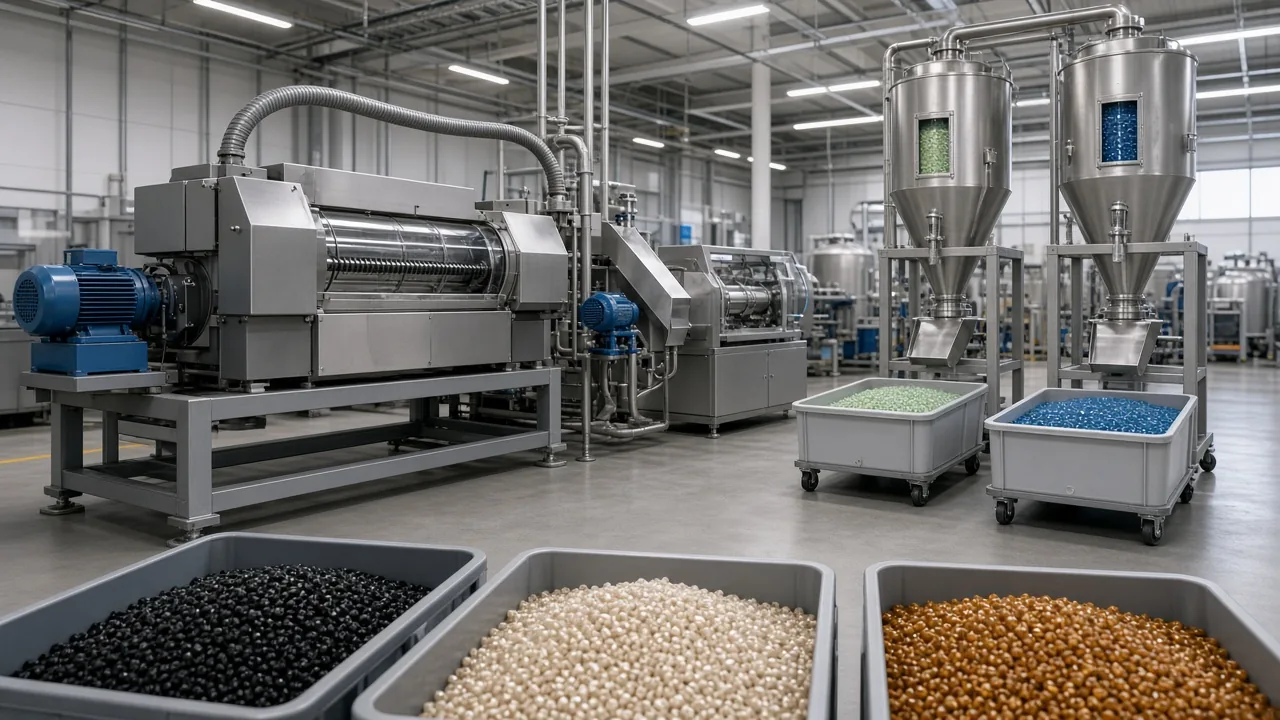
Pellet FGF only delivers its cost and throughput advantage when the feedstock is right: stable 1–5 mm pellets, dry enough for the print day, and compounded for the job (polymer, filled, ceramic, or cement-based). This guide covers how those pellets are made on a production line — and how the market for FGF materials is evolving in 2026.
1. Why pellet feedstock is a separate product from filament
Filament lines (such as a KBL45/28 extrusion line) turn resin into calibrated wire for FDM. FGF platforms skip that step: the printer’s pellet head melts granules directly. That means:
- Lower €/kg — no draw-down, diameter gauge, or winding cost baked into every kilogram
- Higher kg/h on the printer — bulk feed suits furniture shells, fixtures, and LSAM fills
- Broader recipes — filled and composite pellets that are hard to spool as filament
QS C-series FGF machines (C6–C16) and pellet heads (P36 / P45 / P55) are specified for 1–5 mm industrial pellets. Material quality still decides layer bond, warpage, and nozzle life — “any plastic granule” is not a production grade.
2. Anatomy of a pellet material generation line
A typical industrial line for FGF-ready pellets looks like a compact compounding cell, not a full filament plant:
- Resin & additive dosing — virgin or recycled base polymer plus fillers, color, stabilizers
- Twin-screw (or single-screw) compounding — melt mixing for homogeneous pellets
- Strand or underwater pelletizing — cut to the 1–5 mm window the print head expects
- Classification / sieving — remove fines and oversize that jam hoppers or starve screws
- Drying & conditioning — bring moisture to the print recipe before bagging or bulk bins
- QC & packaging — melt flow, moisture, particle-size distribution, lot traceability
Footprint and power are usually smaller than a filament extrusion hall: no long cooling tanks, diameter gauges, accumulators, or servo winders. Capex focus shifts to compounder + pelletizer + dryer + QC.
3. Grades that matter for FGF printers
- Engineering polymers — ABS, ASA, PC, PA and similar for enclosed FGF (furniture, tooling, housings)
- High-temp / specialty — PPS, PEEK and related where chamber and head allow
- Composites — fiber- or mineral-filled pellets for stiffness and reduced warp
- Ceramic & cement formulations — for specialty FGF / LSAM recipes (see Printing Materials)
Buyers often start with ready polymer pellets, then move to custom compounds once print recipes stabilize. In-house lines pay off when monthly kg is high enough to amortize compounder time and QC staff.
4. Market analysis: 2026 demand drivers
4.1 Demand side
- Furniture & sculpture — large shells favor kg throughput; pellet cost dominates job margin
- Fixtures & tooling — short-run jigs where filament €/kg erodes profit
- LSAM / robot cells — high deposition rates need continuous pellet supply, not spool changes
- Medical & regulated shells — still often FDM for fine detail; pellet used for bulk blanks in hybrid cells
4.2 Supply & margin structure
Three supply models compete:
- Off-the-shelf pellets from chemical or compounders — fastest start, least control
- Private-label / custom compounds — printer OEMs or regional partners sell FGF-tuned lots
- Captive production lines — factories that already print tons/month and want recipe IP + cost lock-in
Margin concentrates where the seller owns print-validated recipes (moisture, MFI, particle size) rather than commodity resin alone. Filament still wins thin detail; pellets win bulk mass — hybrid floors grow both markets instead of replacing one with the other.
4.3 Regional pattern
Asia remains the densest supply of compounding capacity and FGF platform manufacturing (including Foshan source factories). Europe and North America buy more finished printers + validated pellets, with selective captive lines in furniture and automotive tooling. Emerging buyers in Southeast Asia and the Middle East often pair one FGF cell with imported engineering pellets before localizing compounds.
5. Build vs buy: when a generation line makes sense
- Buy pellets if you print < a few hundred kg/month or are still locking recipes
- Toll compound if you need custom fills without owning a twin-screw
- Own a line when monthly tonnage, scrap reclaim, or proprietary fills justify QC + operators
Factories that already run a filament extrusion line sometimes add a pelletizing branch for FGF — shared resin warehouse, separate QC specs. Do not assume filament scrap automatically becomes good FGF pellets without re-compounding and size control.
6. Practical checklist for FGF pellet lots
- Particle size mostly inside 1–5 mm; low fines
- Documented moisture after drying for the print day
- Stable melt flow lot-to-lot for the target head (P36 / P45 / P55 class)
- Clear labeling: polymer family, fillers, max print / chamber guidance
- Storage: sealed bins or bags; re-dry after long open exposure
7. How QS fits the stack
QS3Dmachine supplies enclosed FGF platforms, pellet print heads, and pellet & composite materials, plus filament extrusion lines for shops that also run FDM. For production planning see also FGF production guide and hybrid FDM + FGF cells.
Contact sales with your monthly kg target and polymer families — we can recommend buy-vs-build and a matching C-series or LSAM configuration. Quote packs are QS-branded (no third-party PDFs).
Tags: industrial 3D printing, FDM FGF LSAM, filament extrusion, 3D printed furniture, medical 3D printing, sculpture 3D print, local filament factory, QS3Dmachine