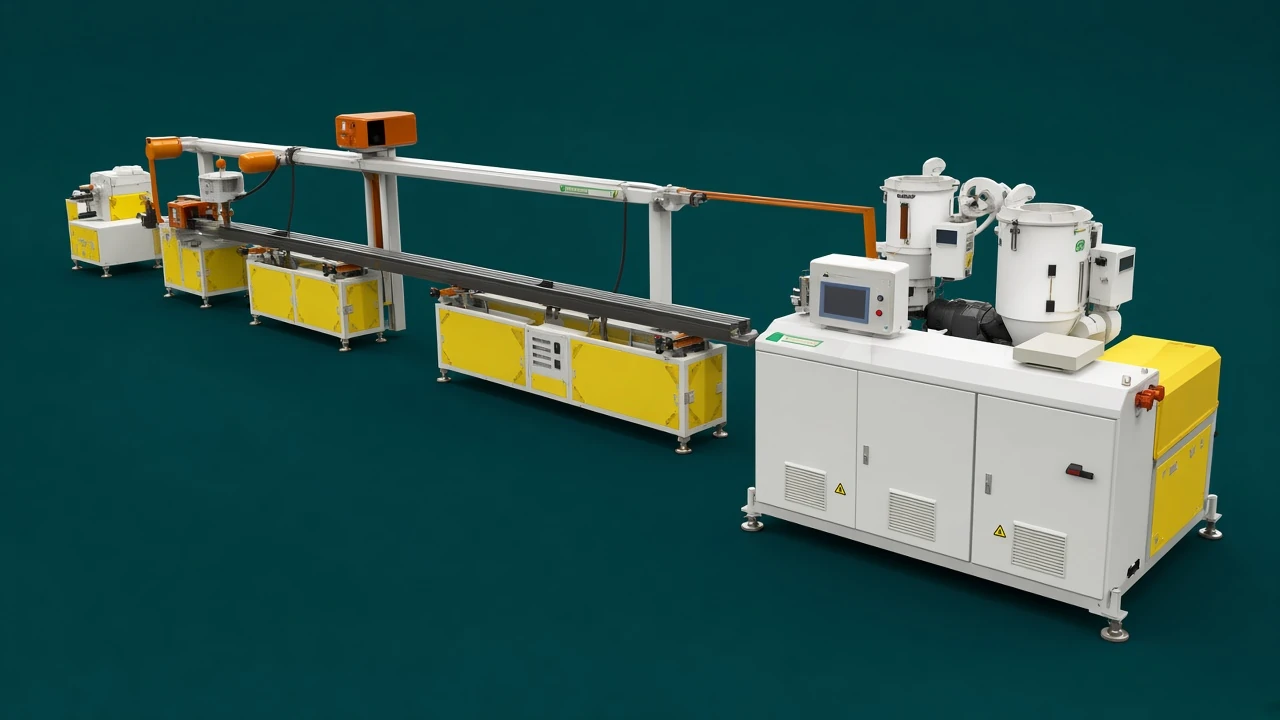
3D filament extrusion lines turn polymer pellets into spooled 1.75 mm or 2.85 mm consumables for enclosed FDM fleets, OEM brands, and compounders. The KBL45/28 turnkey layout covers extrusion, sizing, cooling, online gauging, haul-off, accumulation, and servo winding in one continuous flow.
1. Match output to your market
The KBL45/28 single-screw line is rated for roughly 20–30 kg/h filament output — suitable for a regional filament brand, university material lab, or captive supply for a print farm. Define target diameters (1.75 mm vs 2.85 mm), color runs, and whether you need quick material changeovers between PLA, ABS, PETG, PE, or TPU.
- Downstream demand — link daily kg/h to spool count and warehouse turns.
- Material portfolio — standard grades vs filled or flame-retardant compounds (verify screw/barrel compatibility).
- Quality tier — hobby retail vs industrial FDM (tighter ovality and diameter bands).
2. Understand the eight process modules
A complete line is more than an extruder. The KBL-class configuration typically includes:
- Single-screw extruder — Ø45 mm / 28:1 L/D, nitrided 38CrMoAlA screw & barrel, four heating zones (about 50–350 °C), 5.5 kW servo drive.
- 3D filament die — S136 stainless, short flow path to limit degradation.
- Vacuum calibration & cooling tanks — 304 stainless, multi-stage water loop for stable roundness.
- Online diameter gauge — closed-loop feedback to haul-off speed for ±0.02–0.05 mm class control (verify spec with factory trial).
- Haul-off with hot-air dryer — consistent tension entering the winder.
- Horizontal accumulator — buffer for non-stop spool changes.
- Servo filament winder — programmable length per spool, neat traverse.
See the full equipment layout on our 3D filament extruder category and the KBL45/28 product page.
3. Utilities, footprint, and compliance
Confirm total connected load (extruder heater zones, vacuum pumps, water circulation, winder servos), chilled water quality, and exhaust for volatile grades. Allow floor space for the ~4 m calibration tank section plus safe access for die cleaning. Request CE documentation and export packing if you ship internationally.
4. Integrate with printing & materials strategy
Many buyers pair a filament line with industrial FDM or FGF platforms to validate recipes in-house before scaling sales. Pellet FGF users may still buy spooled specialty grades from the same compound — extrusion and printing R&D share one material lab.
5. Before you sign the PO
- Run a trial with your exact resin lot (moisture pre-dry, melt index).
- Measure ovality and diameter over a full shift, not a five-minute demo.
- Agree on spare die, heater bands, and screw inspection intervals.
- Plan operator training: startup, purge, emergency stop, and winder threading.
Tags: 3D filament extrusion line, PLA filament manufacturing, diameter control, filament winder, single screw extruder, industrial FDM printer, C6 FDM, C9 FDM, engineering filament, production 3D printing, commercial food machinery, food processing equipment, vegetable washer, vegetable cutter, meat cutting machine