
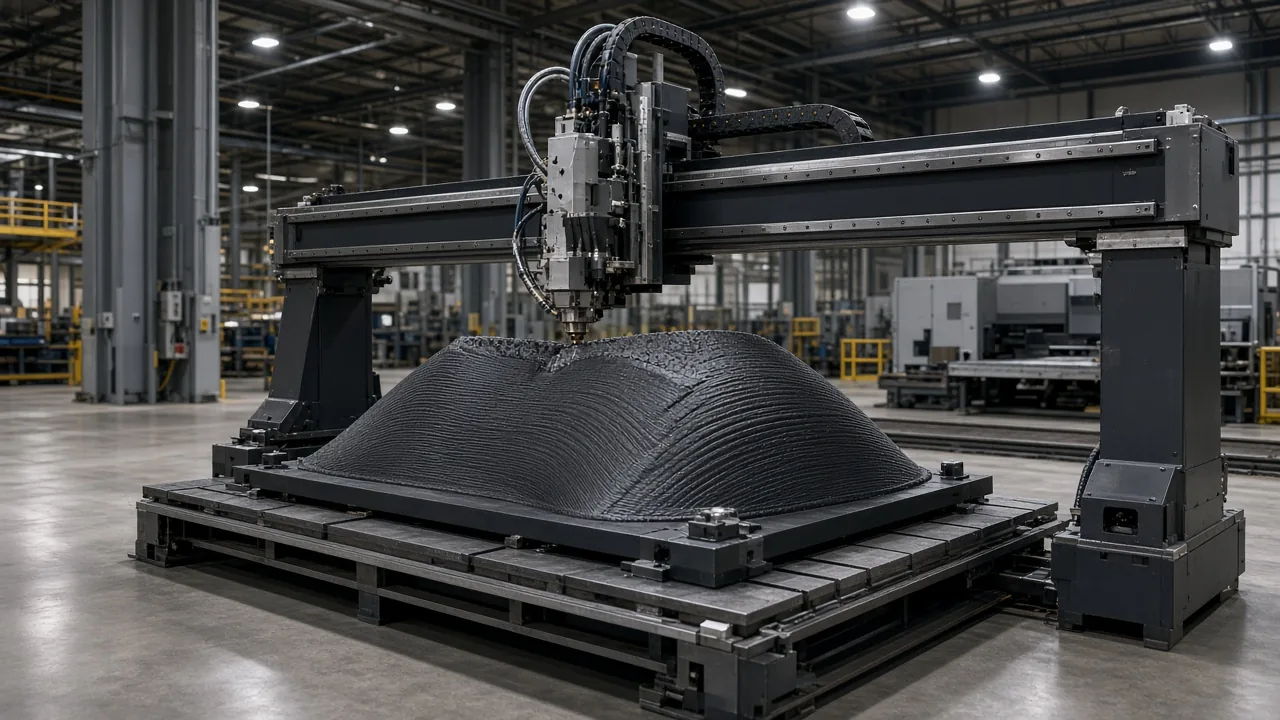
C40-class LSAM wins when the blank is the cost — large molds, fixtures, and composite tools that burn weeks of CNC stock removal. Pellet deposition builds near-net shapes; machining finishes critical surfaces only.
1. Cost stack to model
- Polymer €/kg — pellets undercut filament and often undercut oversized CNC billets
- Deposition hours — P36 / P45 / P55 head class vs target wall thickness
- Finish machining — only datum faces, seals, and mating features
- Changeover — reprint a revised tool without waiting on a new billet
Head matching: pellet print head guide. Robot alternative: robot additive cells.
2. Jobs that usually clear ROI
- Automotive / aerospace layup tools with large envelope and moderate surface class
- Foundry patterns and large jigs where weight and lead time matter
- Architectural molds and sculpture masters that iterate often
3. Jobs that stay on CNC or smaller cells
- Tight-tolerance steel tools with heavy thermal cycles
- Parts that fit enclosed C12/C16 FGF without gantry overhead
- One-off tiny inserts better printed on FDM
4. Site checklist
Power, floor loading, dryer capacity for high kg/h, and crane access for finished tools. Import/FAT notes: China import checklist.
Share your tool envelope and annual tool count for a C40 vs robot vs C16 comparison pack.
Tags: LSAM gantry printer, composite tooling, robot additive manufacturing, meter-scale 3D print, 3D printed sculpture, industrial 3D printing, FDM FGF LSAM, filament extrusion, 3D printed furniture, medical 3D printing, sculpture 3D print, local filament factory, QS3Dmachine