
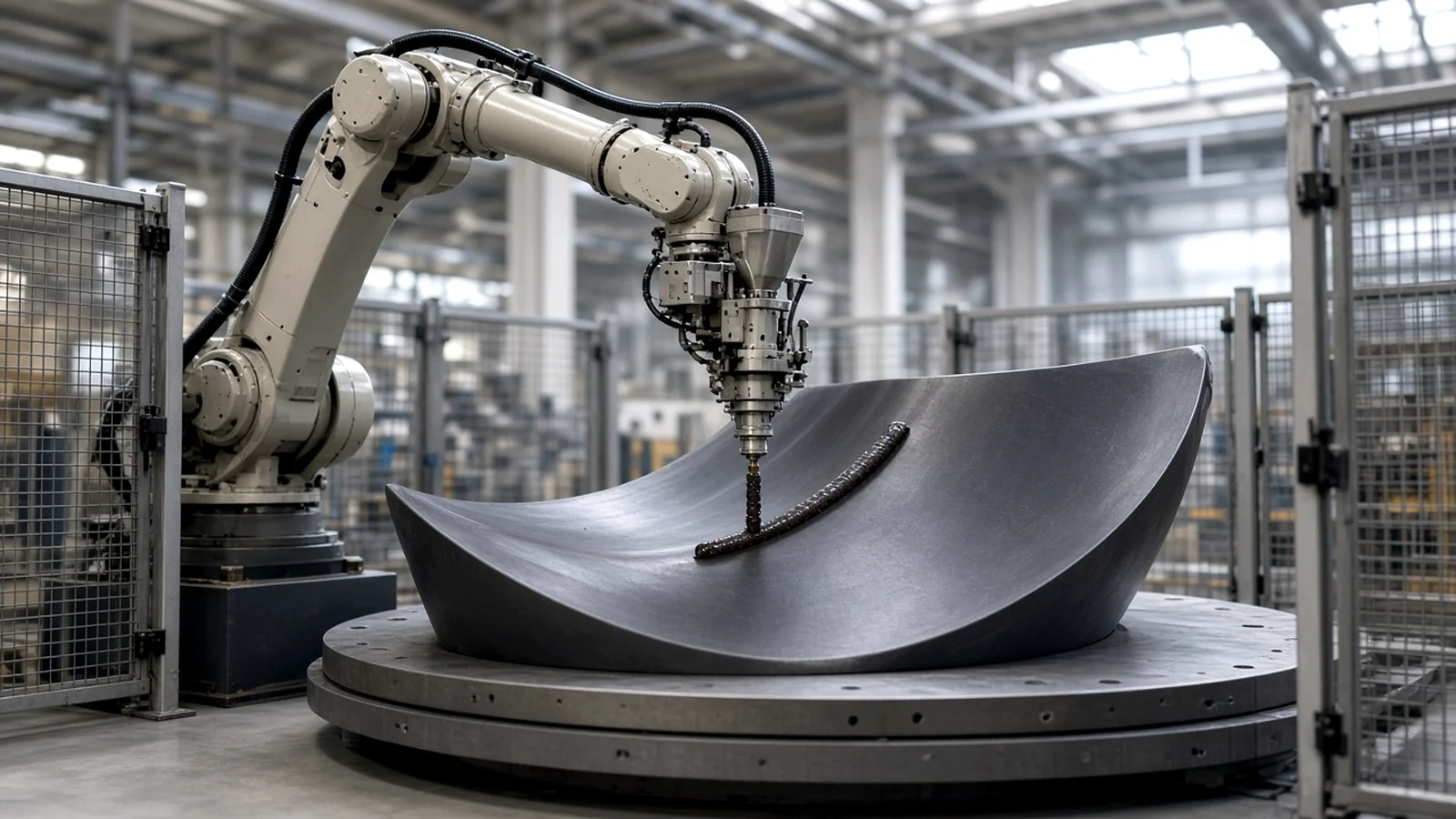
Robot additive cells mount pellet or filament extruders on a 6-axis arm — useful when parts need angled deposition, machining in the same cell, or envelopes that a box gantry cannot reach cleanly.
1. Where robot cells win
- Non-planar toolpaths — conformal layers on molds, ducts, and curved fixtures.
- Hybrid process — print + mill + inspect with tool changers.
- Floor layout flexibility — shared cell for multiple part families.
See our robot series and P-series pellet heads for integration options.
2. When gantry LSAM is simpler
- Large rectangular envelopes with mostly vertical build strategies.
- Teams that want a single, enclosed process envelope and simpler teach paths.
- High-volume fills where a fixed C40 LSAM gantry already matches the CAD.
3. Spec checklist
- Payload vs head weight (P18–P55 class) including heaters and cabling.
- Reach + external axes (turntable / linear track) for your longest part.
- Pellet drying, enclosure, and fume extraction for engineering polymers.
- Offline programming / slicing that exports robot-ready paths.
- Safety fencing, E-stop zoning, and CE / local machine directives.
4. How cells fit a mixed fleet
Many factories keep enclosed FDM/FGF printers for fixtures and detail parts, use robot cells for freeform tooling, and reserve gantry LSAM for meter-scale panels. Captive filament extrusion still supports the FDM side of the shop.
Tags: industrial 3D printing, FDM FGF LSAM, filament extrusion, 3D printed furniture, medical 3D printing, sculpture 3D print, local filament factory, QS3Dmachine