
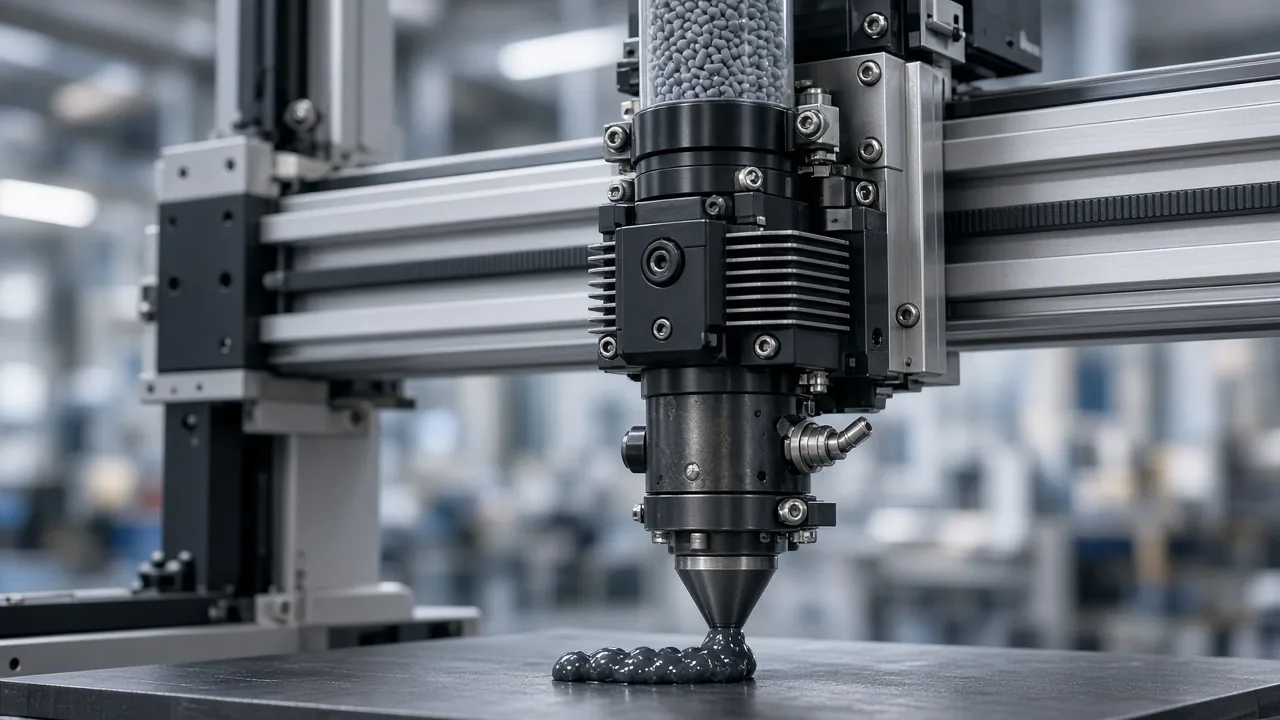
Pellet FGF only scales when the print head matches the machine and the job. Undersize the extruder and you leave deposition rate on the table; oversize it and you fight start/stop quality on fine features. This guide maps QS P18/P20 → P26/P36 → P45/P55 classes to enclosed FGF, robot cells, and C40 LSAM.
1. Three throughput classes
- P18 / P20 — compact cells and lighter end-effectors; typical output on the order of ~12–20 kg/h class (material dependent)
- P26 / P36 — mid-size robot and LSAM fills where reach and duty cycle both matter
- P45 / P55 — high-throughput LSAM and large furniture / tooling shells
All heads target 1–5 mm industrial pellets. Pair with a dryer sized to daily kg — see also pellet feedstock production.
2. Match head to platform
- Enclosed C6–C12 FGF — start with P18–P36 class depending on part mass and chamber time
- Robot additive cells — prioritize mass and cable routing; mid-class heads keep the arm agile
- C40 LSAM gantry — P36 / P45 / P55 options for meter-scale composite tooling and bulk polymer
3. Spec checklist before PO
- Target kg per part and parts per shift
- Polymer family (ABS/ASA/PC/PA… vs filled/ceramic recipes)
- Max melt / heat-zone needs for your grade
- Auto feed path — QS supports suction options without a dedicated shop compressor on many cells
- Spare screws/nozzles and changeover time between recipes
4. Next step
Browse pellet print heads or send your part list for a matched head + platform quote (QS-branded pack, no third-party PDFs).
Tags: LSAM gantry printer, composite tooling, robot additive manufacturing, meter-scale 3D print, 3D printed sculpture, industrial 3D printing, FDM FGF LSAM, filament extrusion, 3D printed furniture, medical 3D printing, sculpture 3D print, local filament factory, QS3Dmachine