
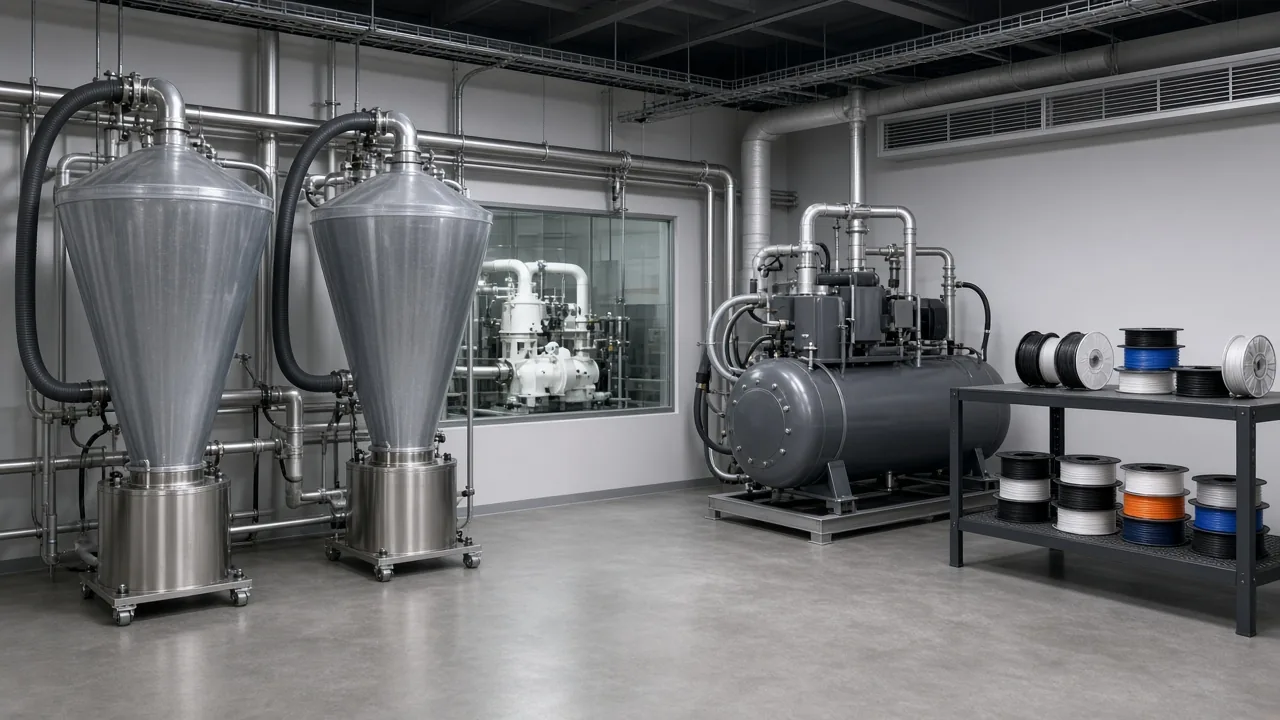
Factories that both make filament and print on FGF often waste capex on duplicate dryers and chillers. One shared utility spine usually wins — if you size peaks for extrusion tanks and print cells together.
Related: hybrid FDM + FGF cells · filament workshop equipment.
1. What both floors actually share
- Dehumidifying dryer air — PA/PC filament pellets and FGF hoppers hate moisture equally
- Chilled water + cooling tower — cold baths on the line; some print auxiliaries and enclosure heat rejection
- Compressed air — vacuum loaders, pneumatics, screen changers, maintenance tools (FGF cells may still offer compressor-free suction options on the printer side)
- Power distribution — 3-phase 380 V class planning for extruders, dryers, chillers, and enclosed printers
2. Sizing rules of thumb
- Sum simultaneous extruder + cold-tank heat load, then add dryer regeneration and compressor — do not use “average day” only
- Dryer hopper volume for filament lines (150–200 L class per busy line) plus FGF day-bins
- Keep fiber compounding dust zone separate from winding and print QC
- Leave floor load and crane paths for C12/C16 or LSAM if print volume grows
3. Layout sketch
Utilities on an outside wall → dryer mezzanine → filament extrusion hall → sealed pack room; FGF / FDM cells in a cleaner bay with short pellet hose runs. Shared spare heaters, belts, and FRL kits cut downtime.
4. Next step
Send hall size, line count, and printer list — we propose one utility BOM plus matched filament lines and enclosed FGF/FDM platforms.
Tags: industriële 3D-printing, FDM FGF LSAM, filamentextrusie, 3D-geprinte meubels, medische 3D-printing, sculptuur 3D-print, lokale filamentfabriek, QS3D-machine