
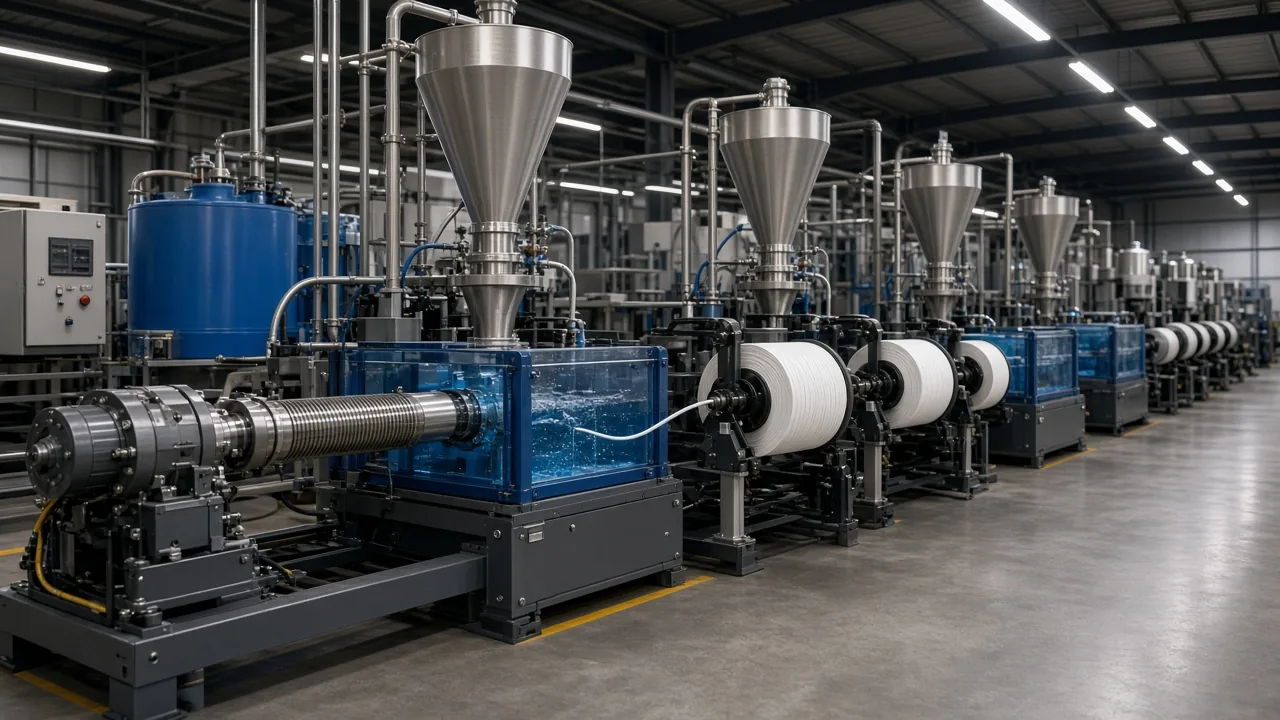
Want a local 3D filament consumables factory without starting from a full compounding plant? This guide lists the machines you need to extrude commercial 1.75 mm filament from ready pellets — engineering grades such as PA6 / PA66 / PA12, PC, ASA, TPU, and later PEI or PC-ABS. A twin-screw pelletizing / compounding line can be added as a second stage; it is intentionally left out of this workshop build.
Related: KBL45/28 filament line buyer guide · local filament factory profit playbook.
1. Workshop target (what you are building)
- Product — B2B / retail spools of 1.75 mm filament (typical tolerance target ±0.02 mm diameter, ovality ≤0.02 mm on engineering RFQs)
- Core cell — one or two independent high-precision single-screw extrusion lines
- Feedstock — purchased or toll-compounded pellets (2.5–3 mm class works well for most FGF-adjacent and filament recipes)
- Site hint from industrial RFQs — roughly 1000 m² hall, ~6 m clear height, 3-phase 380 V confirmed before electrical design
2. Core: high-precision filament extrusion line
Each line should run independently so you can dedicate recipes (e.g. ASA on line A, TPU on line B). A production-minded configuration looks like this:
- Single-screw extruder — ~Ø45 mm screw, L/D 28:1–30:1; barrier mixing geometry; bimetallic wear package if you process fiber-filled pellets
- Temperature window — barrel / die heating capability up to ~420–450 °C if you plan engineering and future high-temp resins
- Filament die + screen changer — calibrated land for 1.75 mm; quick-change manual or hydraulic screen changer
- Hot water tank (1) — 2–3 m, PID-controlled ~80–90 °C; reduces ovality and frozen-in stress on nylon / PC
- Cold water tank (2) — 3–4 m, fed by chilled process water
- Dual-axis laser diameter gauge — closed-loop to haul-off; auto-correct when diameter drifts from 1.75 mm
- Haul-off — belt or roller, servo / VFD, synchronized with the gauge
- Dual-station winder — precision traverse for turn-to-turn spooling; adjustable tension for soft TPU
Typical single-line output on 1.75 mm engineering filament is often quoted around 12–18 kg/h (material dependent). QS KBL-class lines are specified in the ~20–30 kg/h band for common PLA/ABS/PETG/TPU recipes — always validate with your polymer.
3. Must-have auxiliaries (including your add-ons)
3.1 Dehumidifying dryer + vacuum loading
Polyamides and PC need deep drying before the extruder. Spec a dehumidifying dryer with process air dew point down to about −40 °C, hopper capacity in the 150–200 L class (or larger for two lines), plus vacuum loaders from dryer to extruder hopper. Wet pellets are the fastest way to get bubbles and out-of-tolerance diameter.
3.2 Crusher (regrind)
A dedicated crusher / granulator turns purge, start-up scrap, and off-spec filament into regrind. Keep regrind ratios recipe-controlled; engineering and fiber-filled grades need stricter limits than PLA. Place the crusher with dust control away from the clean winding zone.
3.3 Cooling water tower + chiller loop
Cold tanks and barrel heat exchange need stable process water. Pair an industrial chiller sized to all extruders and cold baths with a cooling water tower on the plant roof / utility yard for heat rejection. Undersizing here shows up as warm tanks and rising ovality on hot days.
3.4 Air compressor
A workshop air compressor (with dryer / FRL) supports pneumatic loaders, screen-changer actuators, air knives, and general maintenance tools. Size for simultaneous peak use across both lines, not just average draw.
3.5 Vacuum packaging machine
Finished spools should leave dry. A vacuum packaging machine (plus desiccant packs where needed) protects PA and PC filament in storage and export cartons — especially important for humid destinations and long ocean freight.
4. Utilities & controls checklist
- Total connected load and start-up peaks for extruders, dryers, chillers, compressor
- Water flow rates for hot / cold tanks and tower makeup
- Compressed-air quality (dry, filtered) for pneumatics
- PLC + HMI recipe storage (temps, RPM, haul-off) with language pack for operators
- Spare screws, heaters, belts, laser windows, and screen packs in the first shipment
5. What we are skipping for now (phase 2)
A twin-screw compounding + pelletizing line (loss-in-weight feeders, side feed for CF/GF, vacuum venting, strand pelletizer at ~40–60 kg/h on PA6-CF30 class jobs) lets you make filled pellets in-house. Many factories buy compounded pellets first, prove filament quality on the extrusion lines above, then add compounding. Ask us when you are ready for that RFQ package.
6. Suggested rollout
- One filament line + dryer + chiller/tower + compressor + vacuum packer
- Add crusher once scrap volume justifies reclaim labor
- Second identical extrusion line for recipe isolation / capacity
- Optional later: twin-screw pelletizing for captive CF/GF compounds
Send your target kg/day, polymers, and hall size — QS can configure a turnkey filament extrusion workshop (QS-branded quote pack, no third-party PDFs) and align it with enclosed FDM cells that will consume the spools.
Tags: industrial 3D printing, FDM FGF LSAM, filament extrusion, 3D printed furniture, medical 3D printing, sculpture 3D print, local filament factory, QS3Dmachine