
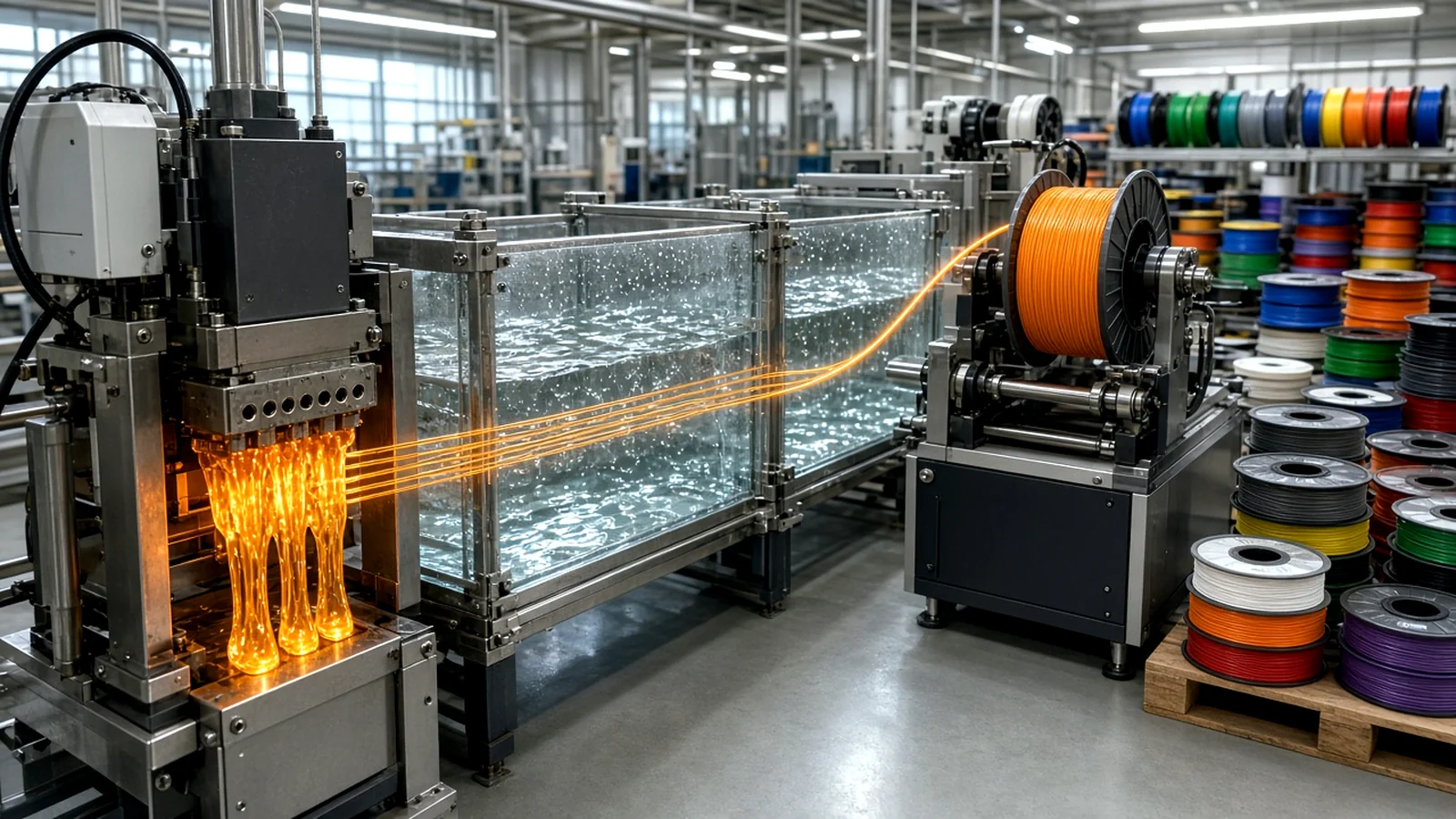
Imported filament eats margin twice: once on the spool price, again on ocean freight and stockouts. A local 3D filament factory flips that — buy pellets by the tonne, run a turnkey extrusion line, and sell fresh 1.75 / 2.85 mm spools to print farms, schools, and brands in your own region. Done right, the line pays for itself while competitors wait on containers.
1. Where the money actually is
- Freight arbitrage — local delivery beats air / sea for heavy spools.
- Pellet → filament spread — commodity PLA/ABS/PETG pellets cost far less per kg than retail filament.
- Captive demand — your own FDM farm or dealer network becomes the first customer.
- Color / custom SKUs — short runs for local brands that importers will not stock.
This is not “get rich overnight” marketing — it is a manufacturing margin you keep when volume is real. Start with one diameter and 2–3 colors, then expand.
2. The KBL-class line that makes it practical
QS3Dmachine’s KBL45/28 filament extrusion line is built as a continuous cell: single-screw extruder → die → vacuum / cooling → online diameter gauge → haul-off → accumulator → servo winder. Typical output is about 20–30 kg/h (material and formula dependent) — enough for a regional brand or a large print farm’s captive supply.
- Ø45 mm / 28:1 screw, multi-zone heating for PLA, ABS, PE, PETG, TPU-class recipes.
- Online gauging for diameter / ovality control buyers expect on industrial FDM.
- Servo winding for neat retail or bulk reels.
Deep dive on modules: KBL buyer guide · setup roadmap: local factory layout.
3. A simple profit sketch (run your own numbers)
- Pick a realistic shift: e.g. 16 h/day × 20 kg/h usable ≈ 320 kg/day before scrap.
- Subtract scrap, color changeovers, and QC holds (plan 5–15% at start).
- Cost stack = pellets + color masterbatch + energy + labor + spool cores + packaging.
- Sell into your city / country at a price under imported brands but above your fully loaded cost.
- Reinvest early cash into dryer capacity and a second winder before adding exotic materials.
Export buyers: ask us for a quote pack with utilities list and footprint — public third-party PDFs stay offline; we send QS-branded docs on request.
4. Go-to-market that fills the winder
- Print farms — weekly standing orders beat one-off retail.
- Schools / Makerspaces — PLA volume with local replenishment.
- Private label — your brand on the spool, your QC story.
- Pair with printers — sell enclosed FDM cells plus captive filament for a sticky package.
5. First 90-day checklist
- Lock target diameter (1.75 vs 2.85), materials, and monthly kg.
- Confirm power, water, and floor length for the ~4 m cooling section.
- Train operators on die cleaning, diameter SPC, and moisture control.
- Ship sample spools to 5–10 local accounts before scaling colors.
- Talk to the source factory for line sizing and commissioning.
Tags: industrial 3D printing, FDM FGF LSAM, filament extrusion, 3D printed furniture, medical 3D printing, sculpture 3D print, local filament factory, QS3Dmachine