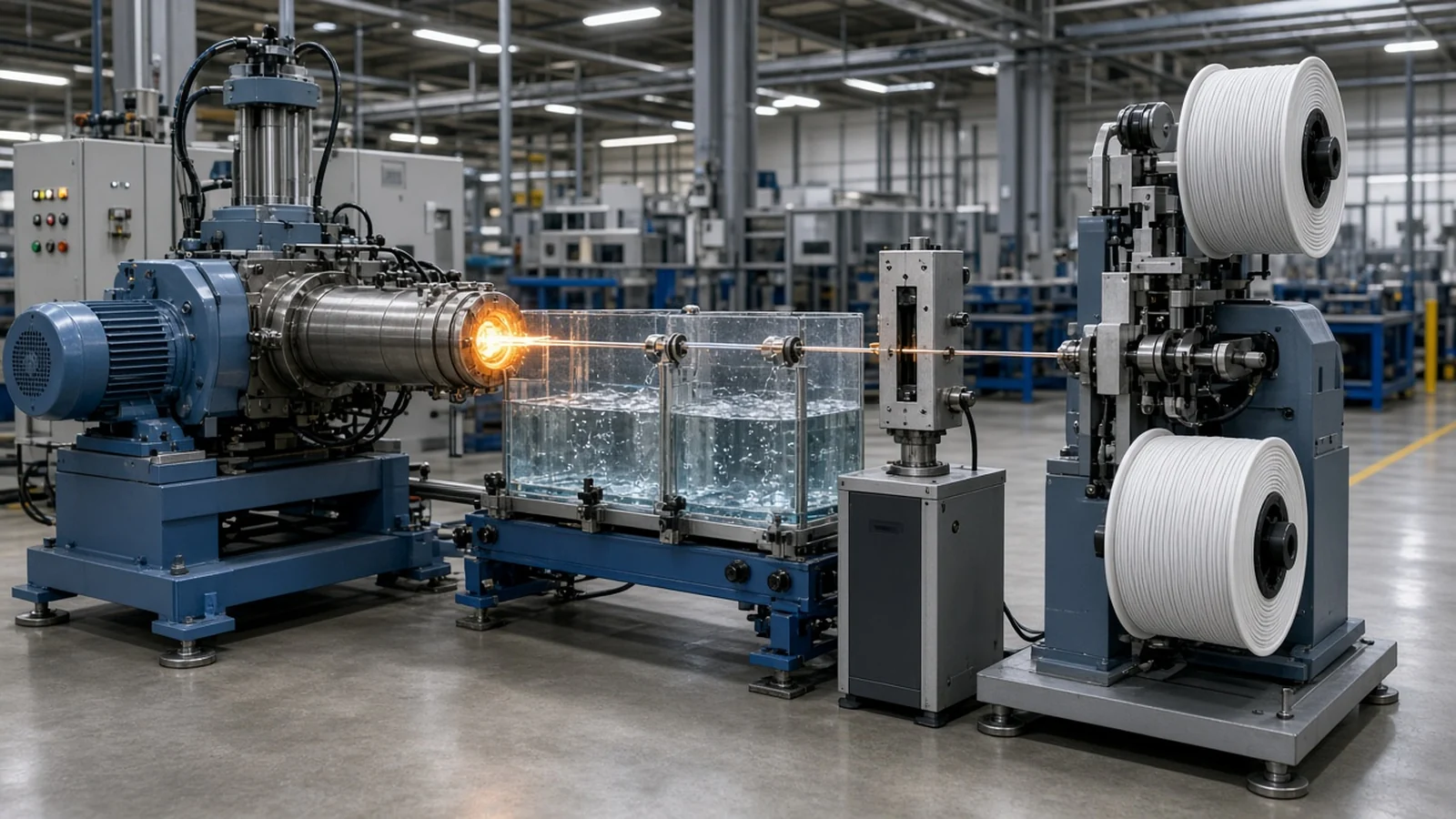
Importing every spool raises cost and lead time. More regional players now ask: can we produce 3D printing filament locally? A turnkey KBL45/28 filament extrusion line (about 20–30 kg/h) is sized for a local factory, university spin-out, or captive supply for an industrial FDM farm.
1. Why localize filament production
- Shorter lead times — days instead of ocean freight for color or diameter changes.
- Margin control — buy pellets, sell branded spools to schools, makerspaces, and factories.
- Application-specific grades — furniture, medical models, or sculpture fleets need consistent diameter and moisture control.
- Industrial synergy — the same site can run enclosed FDM printers to validate every batch.
2. Core equipment for a local plant
A complete KBL-class line typically includes:
- Single-screw extruder (Ø45 mm / 28:1) with multi-zone heating
- 3D filament die (short flow path, mirror-polish)
- Vacuum calibration + stainless cooling tanks
- Online diameter gauge with closed-loop haul-off
- Hot-air dryer / haul-off, horizontal accumulator
- Servo winder for neat 1 kg / 5 kg / industrial spools
Browse the category: 3D filament extruder. Sister materials store: qs3dprinterfilament.com.
3. Site, utilities, and staffing
- Footprint — allow a straight line for extruder → tanks → gauge → winder, plus pellet store and finished-goods racks.
- Power & water — heater zones, servo drives, chillers/circulation pumps; clean cooling water.
- Drying — PETG/ABS need proper pre-dry; humidity control protects spool quality.
- Team — 1–2 operators per shift after training (startup, purge, diameter tuning, spool change).
4. Quality system that buyers trust
Local buyers compare you to global brands. Document:
- Diameter & ovality logs per lot (target bands for 1.75 mm / 2.85 mm)
- Moisture / packaging method (vacuum bag + desiccant)
- Print validation on an enclosed FDM machine (same lot number on spool label)
- MFI / resin certificate from pellet suppliers
5. 90-day launch plan
- Week 1–2 — confirm materials (PLA, PETG, ABS first), power drawing, floor plan.
- Week 3–6 — install line, water loop, exhaust; factory training.
- Week 7–8 — process window trials; lock recipes for two diameters.
- Week 9–12 — soft launch to local schools / print farms; collect feedback; add colors.
6. Pair printing + extrusion for a regional hub
The strongest local model is a filament factory + industrial print cell: sell spools, and offer contract printing for furniture mockups, medical models, or sculpture maquettes. See also our earlier line guide: KBL45/28 buyer guide.
Tags: industrial 3D printing, FDM FGF LSAM, filament extrusion, 3D printed furniture, medical 3D printing, sculpture 3D print, local filament factory, QS3Dmachine