
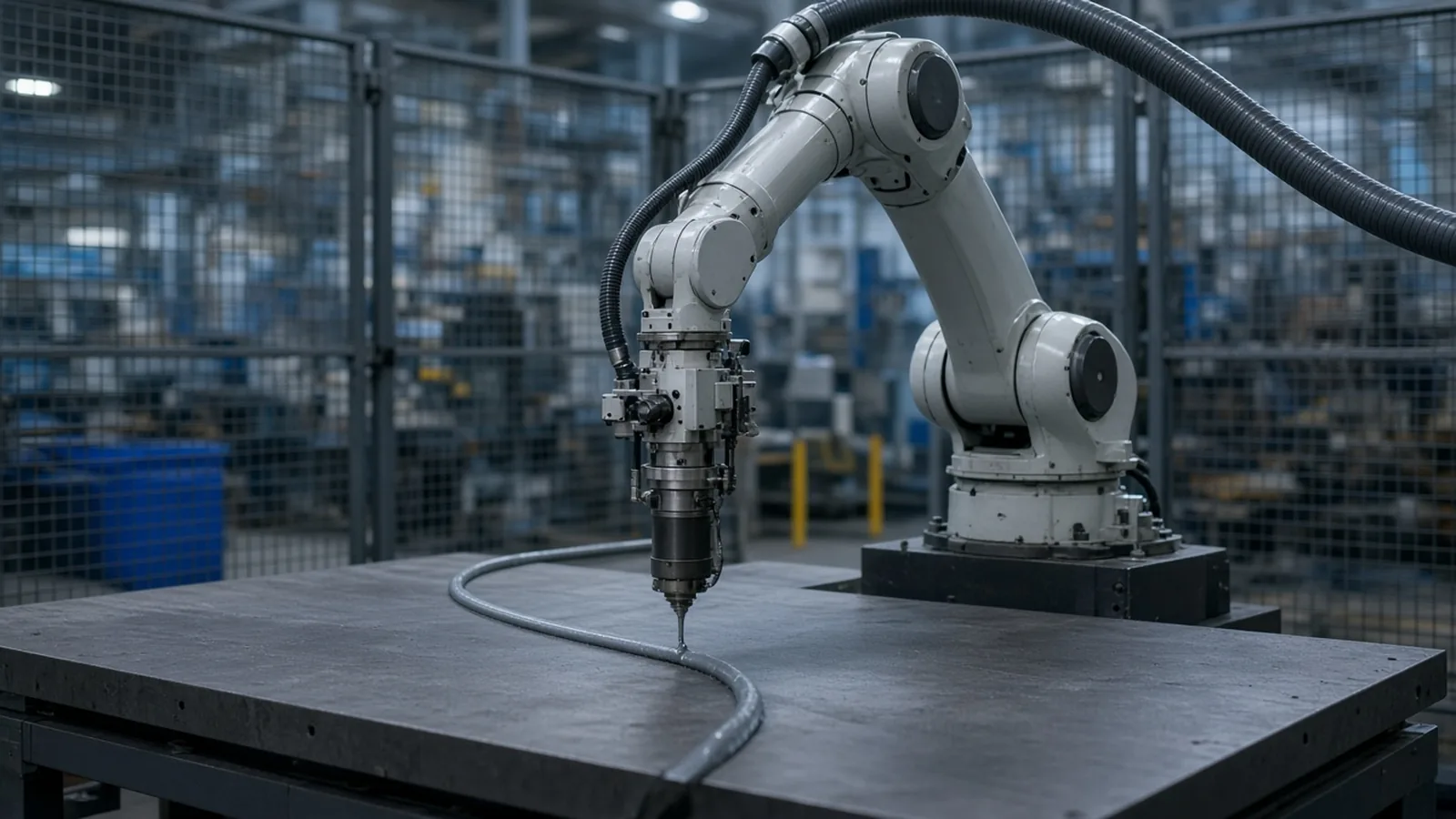
A robot + pellet print head cell is not “a gantry with more axes.” Flange payload, hose spring-back, and tool-center-point (TCP) drift dominate bead quality long before slicer flow multipliers matter. This deep dive is for buyers sizing robot additive cells and P-series heads.
Related: P18–P55 selection · robot cell buyer guide.
1. Mass and inertia on the flange
- Head dry mass — compact P18/P20 class for lighter arms; P26/P36 for mid throughput; leave payload margin for heaters, sensors, and a full melt column
- Center of gravity — a long screw barrel ahead of the flange multiplies wrist torque on 180° reorients; ask for CoG drawing with hopper empty vs primed
- Stop categories — emergency stop with molten polymer still pressurized needs defined purge / retract behavior, not only robot brake specs
2. Hose feed vs onboard hopper
- Remote dryer → hose → head — keeps wrist mass down; hose stiffness and bend radius become process variables (kinks = starvation marks)
- Onboard / near-arm hopper — shorter melt path, higher wrist load; better for short beads and frequent material changes
- Compressor-free suction options — useful where shop air is dirty or metered; still verify dryer dew point for PA/PC pellets
3. TCP, calibration plate, and long beads
Long architectural or furniture beads expose TCP error as seam mismatch. A practical equipment acceptance pack:
- Four-point TCP check at cold and at operating barrel temperature (thermal growth is real)
- Calibration plate print at three reach zones: near base, mid, extended — measure bead width and Z
- Singularity map for the part family; prefer wrist postures that keep the screw axis near vertical when possible for FGF
4. Path planning that respects the melt pump
- Match robot TCP speed to head kg/h — accelerating the arm without ramping screw RPM creates thin corners
- Plan purge towers / wipe moves where hose slack will not yank the flange
- For multi-layer walls, keep consistent approach vectors so hose torsion does not accumulate
5. Next step
Share robot brand/payload and target kg/h — we pair a P-class head, feed method, and SAT checklist for your cell.
Tags: stampa 3D industriale, FDM FGF LSAM, estrusione di filamento, mobili stampati in 3D, stampa 3D medica, stampa 3D di sculture, fabbrica locale di filamenti, QS3Dmachine