
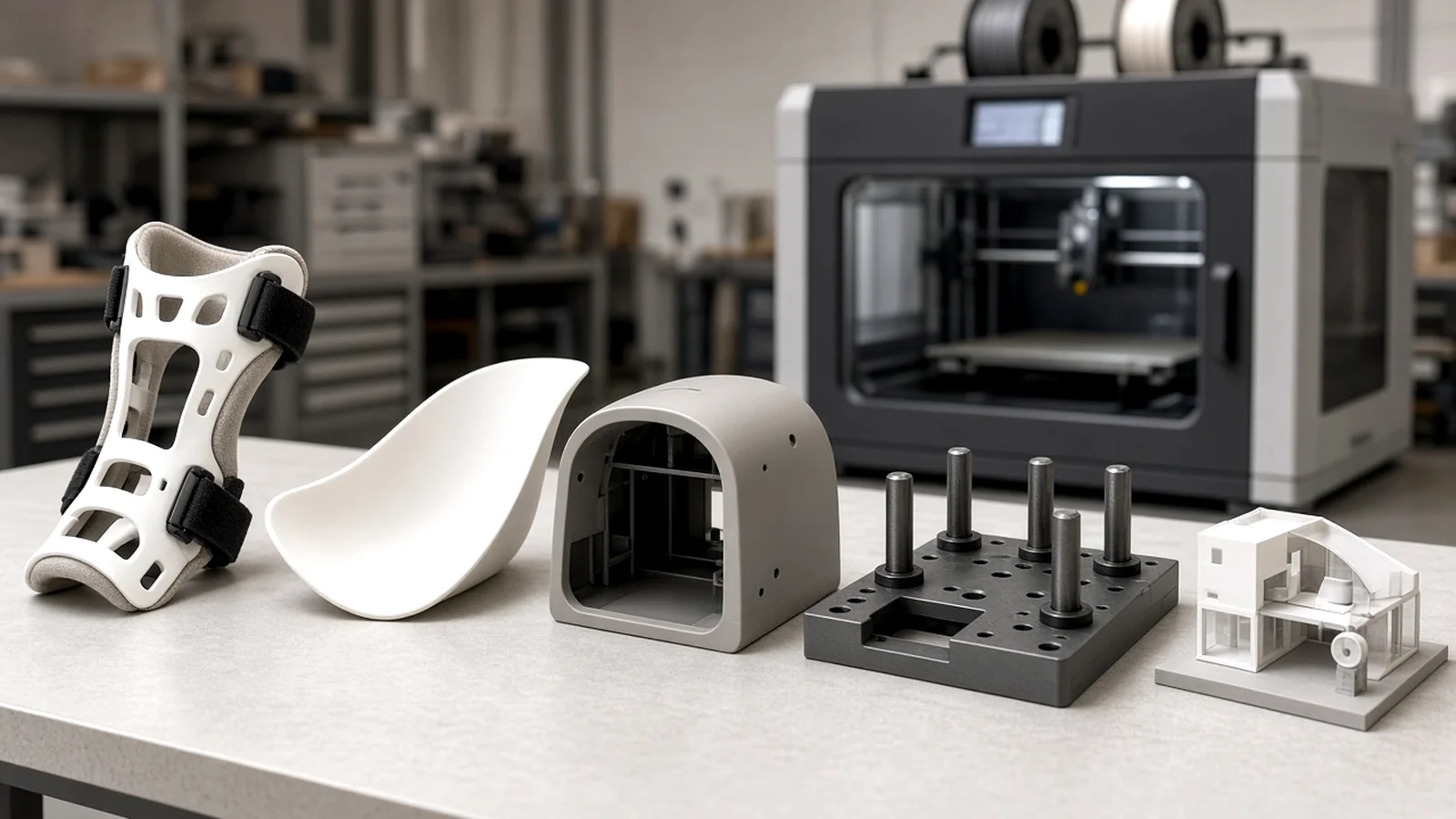
Industrial enclosed FDM and plastic-pellet FGF printers earn their floor space when they replace slow outsourcing across several jobs at once. Below are the application scenarios buyers ask about most — and which QS platforms usually fit.
1. Medical braces & orthotics
Patient-specific ankle–foot orthoses, cranial helmets, and support braces need dimensional stability, smooth contours, and engineering polymers. Enclosed chambers keep ABS/ASA/PA-class materials from warping; dual-capable cells can switch to fine filament when logos or thin features matter.
- Best fit: C6 / C9 enclosed cells
- Pellet FGF cuts material cost on bulk shells; filament mode for detail
- See: pellet drying for braces · medical FDM setup
2. Home & furniture design
Parametric seating shells, lamp bodies, wall fixtures, and short-run interior pieces benefit from large enclosed envelopes and FGF throughput. Design studios iterate CAD in days instead of waiting on mould tooling.
- Best fit: C9 / C12 FGF; meter-scale work → C40 LSAM / robot cells
- Guide: furniture production buyer guide
3. Product hand boards (prototypes)
Appearance and assembly hand boards — housings, consumer-electronics mockups, packaging forms — need repeatable surfaces and fast design loops. Industrial FDM beats desktop farms on chamber control and build volume for larger products.
- Best fit: C6–C12 FDM for detail; FGF when the prototype is bulky and cost-sensitive
- Materials: ABS/ASA for paint-ready parts, PETG for functional fits
4. Jigs, fixtures & shop tooling
Drill guides, nest fixtures, assembly jigs, and soft jaws are classic AM ROI: print overnight, put on the line tomorrow. Pellet FGF is strong when fixtures are large and polymer-heavy; enclosed FDM wins on tight tolerances and small locating features.
- Best fit: production cells on the shop floor (C9–C16 class) or robot cells for awkward envelopes
- Tip: design for print orientation and replaceable wear pads
5. Product models & presentation pieces
Sales models, architecture maquettes, training cutaways, and showroom pieces need clean geometry and reliable scheduling. Start on enclosed FDM for scale models; move sculpture-scale or cultural pieces to FGF / LSAM / robot when size explodes.
- Best fit: C6–C12 for desk/showroom models; sculpture / LSAM guide for large installs
6. How to choose a platform quickly
- Envelope — will it fit C6/C9, or do you need C12/C16 / gantry / robot?
- Material economics — filament detail vs pellet kg cost
- Environment — chamber heat for engineering plastics
- Volume — one-off models vs daily fixtures / braces
Compare series on our platform comparison page, browse applications, or request a QS-branded quote pack for your part list.
Tags: industrial FDM printer, C6 FDM, C9 FDM, engineering filament, production 3D printing, 3D printed furniture, industrial 3D printing, FDM FGF LSAM, filament extrusion, medical 3D printing, sculpture 3D print, local filament factory, QS3Dmachine