
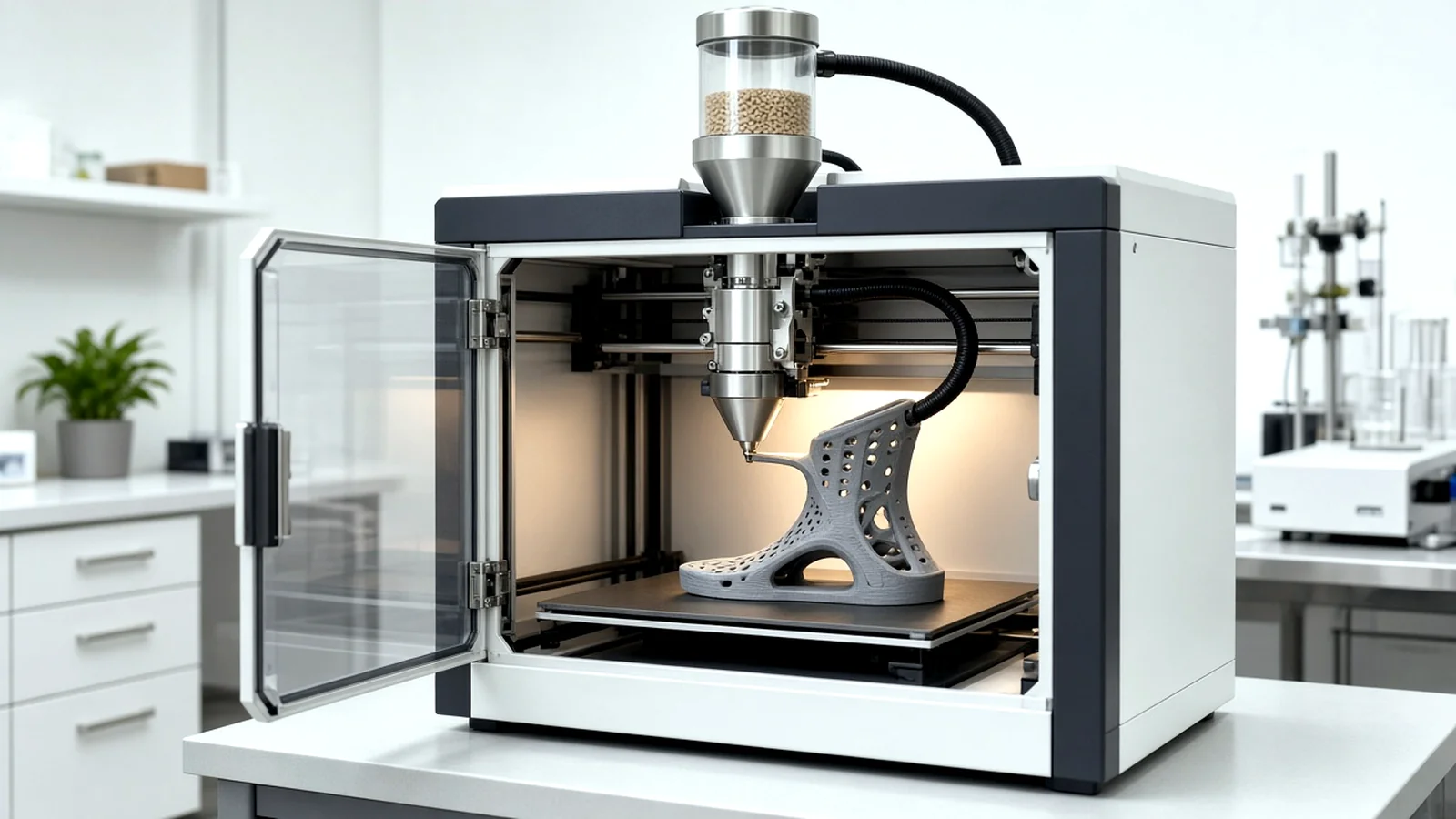
Medical brace and orthotic shops that adopt plastic pellet (FGF) printers win on material cost — but only if pellets stay dry and feed reliably. At QS3Dmachine we design enclosed industrial cells with automatic suction that does not need a dedicated air compressor, so clinics and mid-size labs can run cleaner utilities.
1. Why moisture kills brace quality first
- Wet PA / PETG / TPU pellets foam at the nozzle → weak layers and rough brace skins.
- Dimensional drift shows up on ankle–foot and cranial contours before tensile tests do.
- Filament spools hide the same physics; pellets just expose it faster at higher kg/h.
2. Dryer + auto feed without shop compressed air
Our pellet platforms pair a hopper / dryer path with machine-side auto suction — granules move into the screw without a plant air compressor for basic feed. That cuts install scope for brace labs that never budgeted a compressor room.
- Match dryer capacity to daily kg (not peak marketing throughput).
- Keep closed containers between dryer and hopper; avoid overnight open bags.
- Confirm suction plumbing with our engineers for the C6–C16 class you choose.
Factory context: source-factory pellet overview and workshop photos.
3. Precision envelope for orthotics
- Enclosed chamber / bed control for engineering polymers used in braces and jigs.
- Fine filament mode still available on dual-capable cells when ultra-detail sockets or logos matter.
- Start sizing on C6 / C9; step up when batch volume or envelope grows.
4. Buyer checklist
- Brace materials list + max daily kg.
- Need compressor-free feed? Confirm on the quote.
- Post-process: sanding, padding, strap hardware clearances.
- Compare platforms then request a QS-branded quote pack.
Tags: industrial 3D printing, FDM FGF LSAM, filament extrusion, 3D printed furniture, medical 3D printing, sculpture 3D print, local filament factory, QS3Dmachine