
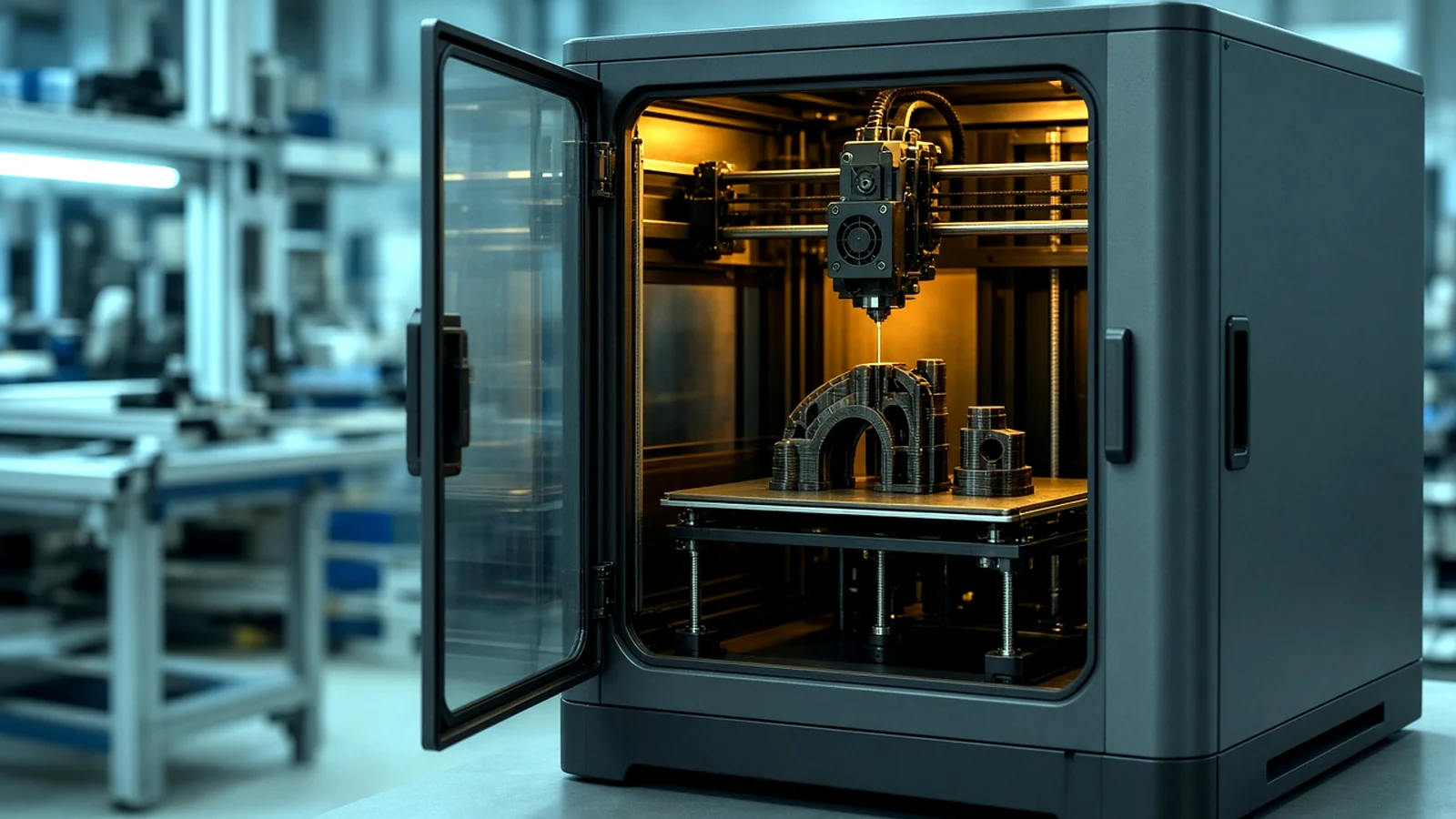
On industrial enclosed FDM, chamber temperature is as important as nozzle rating. Cool ambient air around a hot bead drives warping on ABS/ASA and weak layers on PC and PEI — even when the hotend can melt the polymer.
1. What chamber heat actually does
- Slows cooling — keeps layers above glass-transition longer for better bonding.
- Stabilizes geometry — reduces corner lift on large flat parts and fixtures.
- Enables engineering grades — ASA, PC, PA-CF, and PEI need sustained enclosure heat, not only a heated bed.
2. Practical temperature bands
- ~40–60 °C — PLA/PETG production, low warpage risk.
- ~70–90 °C — ABS/ASA housings and outdoor parts.
- ~90–120 °C+ — PC and many fiber-filled nylons.
- Up to ~200 °C class — high-temp platforms (see C6-HT) for PEI / PEEK-class workflows when process windows allow.
Always confirm the material datasheet and your dryer / moisture control — wet filament fails before chamber heat can help.
3. Spec checklist before you buy
- Active chamber heater vs passive enclosure only.
- Bed temp ceiling and surface (aluminum, PEI sheet, vacuum fixture).
- Nozzle range (≤400 °C class on many QS enclosed cells) vs real material window.
- Part envelope — large fixtures need heat and volume; see C9 / C12.
- When pellet FGF is cheaper for bulky fills — compare FGF vs filament.
4. Where high-temp FDM still loses to FGF / LSAM
Meter-scale molds and furniture shells often move to pellet heads, C40 LSAM, or robot cells. Keep enclosed FDM for precision housings, medical models, and engineering fixtures — request a quote pack for series build volumes.
Tags: 工業用3Dプリント、FDM FGF LSAM、フィラメント押出、3Dプリント家具、医療用3Dプリント、彫刻3Dプリント、ローカルフィラメント工場、QS3Dマシン