
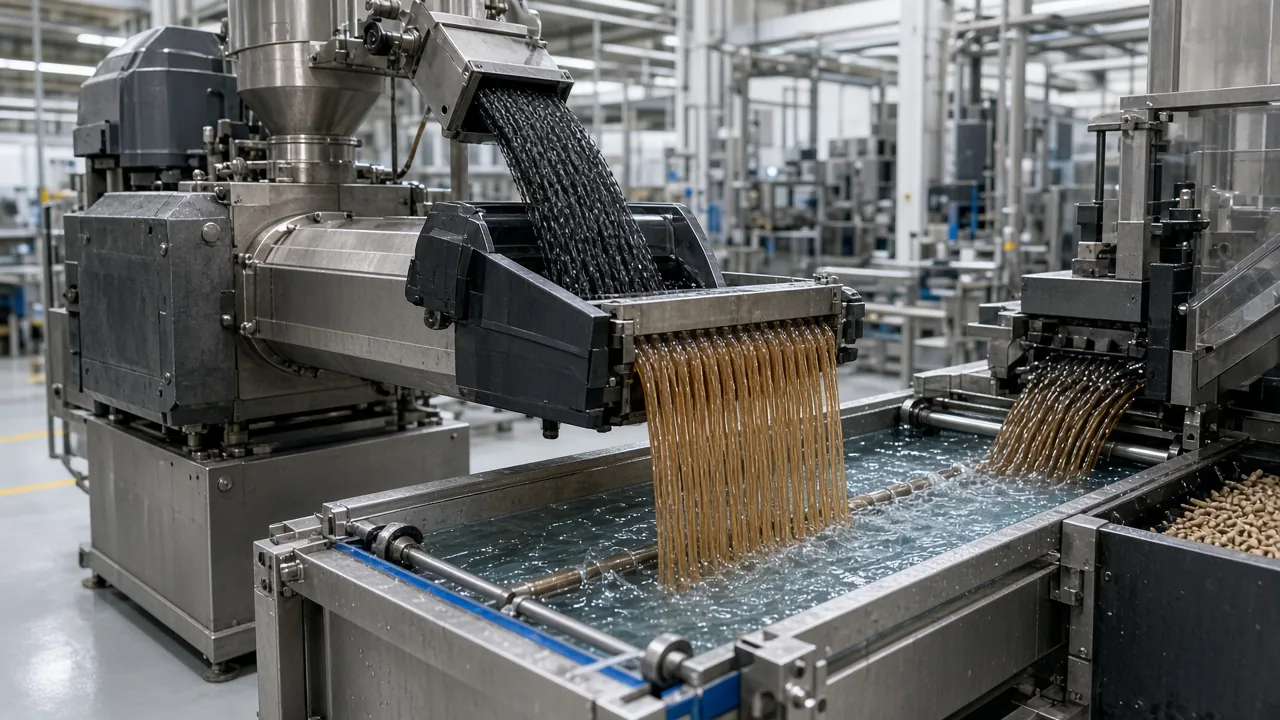
Most shops should prove filament extrusion first on bought or toll-compounded pellets. When monthly filled-grade demand climbs — PA6-CF, GF blends, flame-retardant packages — a captive twin-screw compounding + pelletizing cell becomes the logical Phase 2. This guide maps that upgrade without reopening the full turnkey RFQ.
Phase 1 equipment map: filament consumables factory equipment list.
1. Triggers to add compounding
- You buy the same CF/GF compounds every month and margin leaks to the compounder
- Recipe IP matters (proprietary fiber %, color, FR packages)
- You already run two filament lines and need a dedicated pellet supply buffer
- Scrap reclaim needs re-compounding, not just cold crush into the extruder
2. Core compounding cell (industrial RFQ class)
- Co-rotating twin-screw — screw Ø ~35–40 mm, L/D ≥40:1, modular screw elements for shear / kneading swaps
- Wear package — bimetallic screws and barrel liners (e.g. CPM 10V / WR5 class, ≥60–62 HRC) for CF/GF abrasion
- Main feeder — loss-in-weight dosing for base resin
- Side feeder — abrasion-resistant, typically barrel zone 5–6, gentle fiber addition downstream
- Vacuum vent — ≥2.2 kW class vacuum for PA moisture and volatiles
- Strand cooling + pelletizer — ≥4 m water bath, air knife, target pellet ~2.5–3 mm for the filament lines
Reference throughput on PA6-CF30 class jobs is often quoted around 40–60 kg/h — size dryers and silos so pellets stay dry before the filament extruders.
3. Temperature & materials window
- Barrel zones up to ~400 °C with ±1 °C control for engineering resins
- Start recipes: PA6 / PA66 / PA12, PC, ASA, TPU; plan later for PEI / PC-ABS if heaters and dies allow
- Fillers: short CF or GF up to ~30%, minerals, FR additives — validate fiber length retention vs print / filament quality
4. How it plugs into the filament hall
Keep compounding in a dusty / fiber zone; keep winding and vacuum packing clean. Shared utilities: dehumidifying dryer loops, cooling tower / chiller, compressor. Pellets go dryer → vacuum loader → KBL-class filament line (Ø45 mm class, hot/cold baths, laser gauge, dual winder).
Acceptance mindset from export RFQs: prove continuous stable runs and geometric tolerance on the filament side (e.g. 1.75 mm ±0.02 mm) before signing off the full plant.
5. Buy vs toll vs own
- Toll compound — lowest capex while recipes stabilize
- Own twin-screw — when kg/month and IP justify operators + QC (MFI, moisture, pellet size)
- Hybrid — captive CF grades + purchased commodity pellets
6. Next step
Send your monthly CF/GF kg target and current filament line count — we quote Phase 2 compounding as an add-on to the extrusion workshop (QS-branded pack, no third-party PDFs).
Tags: industrial 3D printing, FDM FGF LSAM, filament extrusion, 3D printed furniture, medical 3D printing, sculpture 3D print, local filament factory, QS3Dmachine