
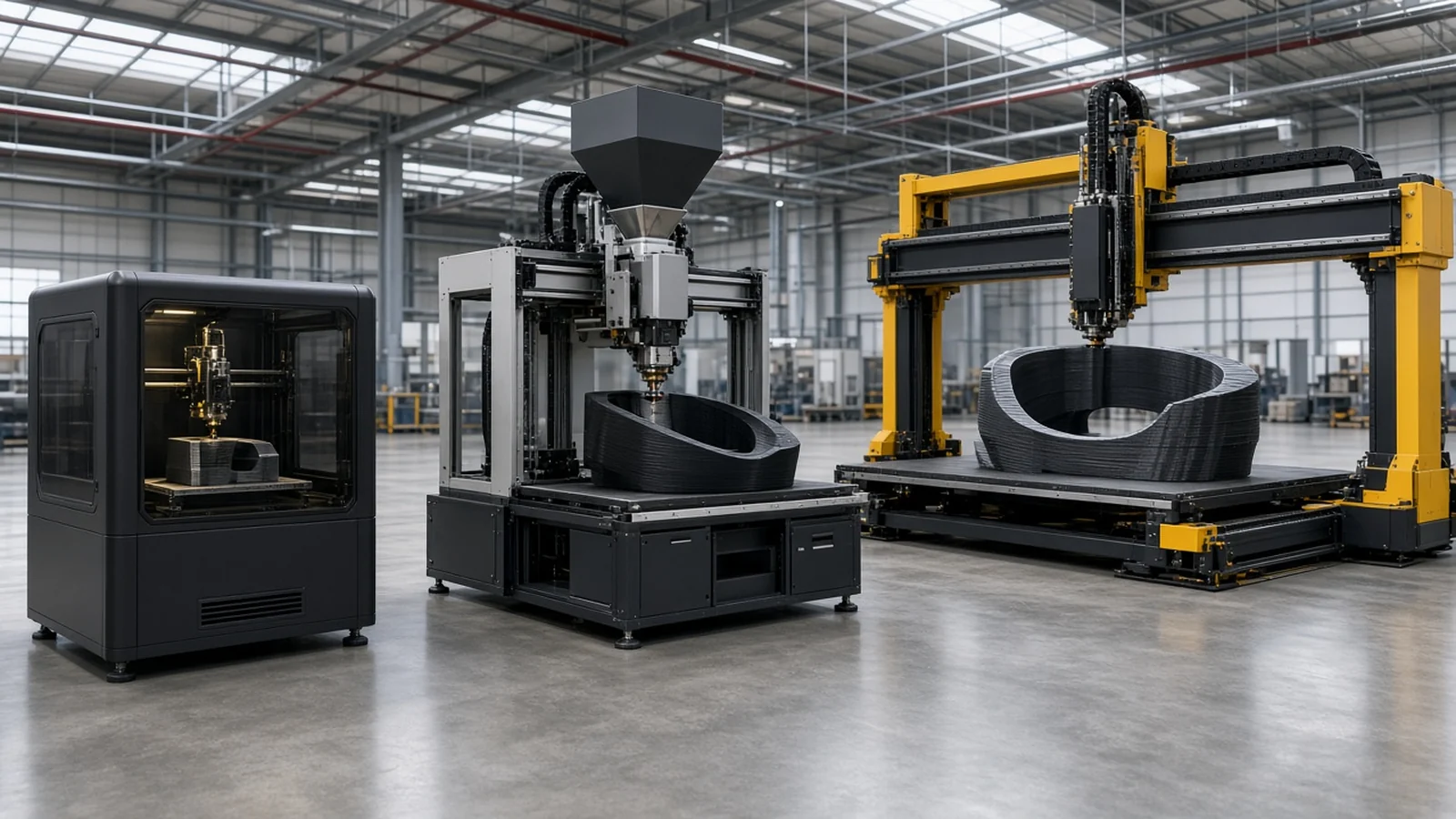
Industrial additive manufacturing is no longer limited to aerospace jigs. Furniture brands, medical device teams, and sculpture studios now specify enclosed FDM, pellet FGF, and large-format LSAM platforms to cut tooling cost, shorten iteration cycles, and produce one-off or short-run pieces that CNC alone cannot justify.
1. Furniture: custom seating, fixtures, and architectural fills
Design furniture and interior brands use industrial 3D printing for:
- Parametric seating & lighting — lattice shells and organic forms that are expensive to mold.
- Showroom fixtures & retail displays — brand-specific shapes without steel tooling.
- Architectural inserts — wall panels, acoustic parts, and facade prototypes.
Enclosed FDM / FGF printers (C6–C16 class) suit mid-size furniture components and furniture-grade polymers. For meter-scale chairs, benches, or outdoor sculpture-furniture hybrids, C40 LSAM or robot cells with pellet heads keep material cost down versus spool filament.
2. Medical devices: models, jigs, and custom interfaces
Medical and dental labs increasingly need:
- Anatomical models for surgical planning and training (rigid and flexible grades).
- Jigs, guides & fixtures for assembly or clinical workflows.
- Patient-specific interfaces — orthotics trials, housings, and ergonomic grips (subject to local regulatory pathways).
Enclosed, temperature-controlled FDM platforms help with engineering plastics (ABS, ASA, PC) and dimensional stability. Clean-room adjacent shops also value sealed chambers and predictable filament drying — often supported by a captive filament extrusion line for controlled batches.
3. Sculpture & cultural projects: from maquette to monument
Artists and foundries use additive manufacturing to:
- Print large maquettes for client approval before casting.
- Build lost-pattern shells or molds for metal/resin casting.
- Deliver permanent polymer sculptures for outdoor or indoor install.
Pellet FGF and LSAM excel when part size exceeds 1–2 m and material volume is high. Robot additive cells add milling for surface finish on sculpture skins.
4. How to choose FDM vs FGF vs LSAM
| Need | Prefer |
|---|---|
| Fine detail, medical housings, furniture connectors | Enclosed FDM (C6 / C9 / C12) |
| Large furniture shells, high polymer volume, lower cost/kg | FGF pellet (C9–C16) or LSAM |
| Meter-scale sculpture / outdoor pieces | C40 LSAM or robot + pellet head |
| Controlled filament grades for medical/furniture fleets | KBL filament extrusion + FDM farm |
Read the platform overview: FDM vs FGF vs LSAM.
5. Project checklist before you buy
- Define max part envelope, annual polymer tonnage, and finish level (as-printed vs machined).
- Confirm material certifications needed for medical or furniture markets.
- Plan utilities: power, enclosure exhaust, pellet drying, and floor load for gantries.
- Request a trial print with your CAD — not a generic demo part.
Tags: промисловий FDM-принтер, C6 FDM, C9 FDM, інженерний філамент, виробниче 3D-друкування, 3D-друковані меблі, промислове 3D-друкування, FDM FGF LSAM, екструзія філамента, медичний 3D-друк, 3D-друк скульптури, місцева фабрика філамента, QS3Dmachine