
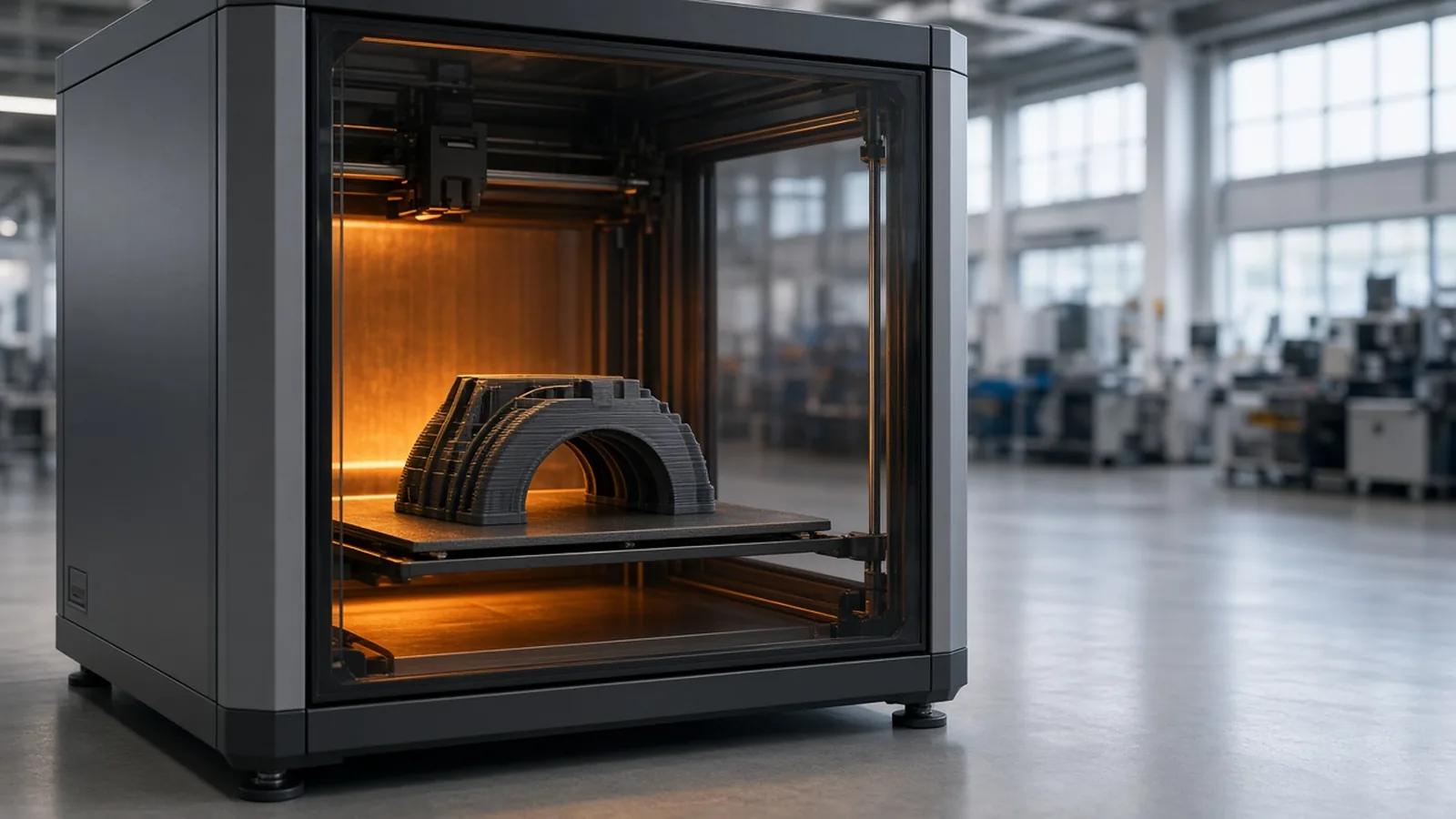
On C12 and C16 enclosed platforms, most “mystery warp” is not a slicer bug — it is chamber air stratification, bed-to-air delta-T, and door-seal leakage fighting the polymer’s glass transition. This note digs into the machine side, not generic print tips.
Series context: C6–C16 picker · high-temp cells: enclosed HT FDM.
1. What the enclosure actually controls
- Air temperature band — for ABS/ASA you typically hold a warm shell; for PC and filled grades you push hotter air so layer interfaces stay above the brittle zone
- Bed surface — aluminum alloy platforms on C12/C16 carry their own heater; bed setpoints ≤160 °C class on many configs, independent of chamber air
- Door / glass leakage — every open cycle dumps stratified hot air; long FGF beads on C16-MAX feel door discipline more than small C6 jobs
2. Stratification: why top and bottom disagree
Tall builds (C12-FGF ~1.0–1.2 m Z; C16-FGF-MAX up to ~2.4 m Z) create a vertical gradient. Hot air rises; the first 200–300 mm near the bed can run cooler than the head height. Practical equipment responses:
- Verify chamber sensor height vs nozzle working height — a single sensor at mid-door is not a volume average
- Allow a longer soak before first layer on MAX frames; thermal mass of 510–560 kg C12-class and heavier C16 frames matters
- Avoid blasting shop HVAC directly at the enclosure face — it defeats seals faster than bad slicer settings
3. Spec anchors buyers should ask for
| Item | C12-class (typical) | C16-class (typical) |
|---|---|---|
| Build envelope (FGF) | ~1100×1000×1000–1200 mm | ~1600×1300×1250–2400 mm |
| Nozzle range (FGF) | 0.6–8.0 mm | 0.6–8.0 mm class |
| Frame mass | ~510–560 kg | heavier gantry / MAX frames |
| Drive | Full servo | Full servo |
RFQ language that helps: “chamber air ±X °C at nozzle height after 60 min soak,” “door-open recover time,” and “bed flatness at operating temperature.”
4. Process pairs that fail without chamber discipline
- PC / PC-ABS shells — corner lift usually tracks cold air curtains, not only bed PEI choice
- Wide FGF beads — large nozzles dump heat into the part; without stable chamber air, the skin cools while the core stays soft
- Multi-day C16 jobs — night shop temperature swings show up as banding if the enclosure cannot hold set point unattended
5. Next step
Send polymer, part height, and target tolerance — we map a C12 or C16 thermal recipe and enclosure options before you lock the PO.
Tags: ipari 3D nyomtatás, FDM FGF LSAM, filamentum extrudálás, 3D nyomtatott bútorok, orvosi 3D nyomtatás, szobor 3D nyomtatás, helyi filamentum gyár, QS3Dgép